

A coin, and a verdict on it
A graded coin has been examined by an independent authority, scored out of seventy, and sealed in a case that holds it at that score. The number travels with the coin for the rest of its life, and every future buyer reads it the same way.
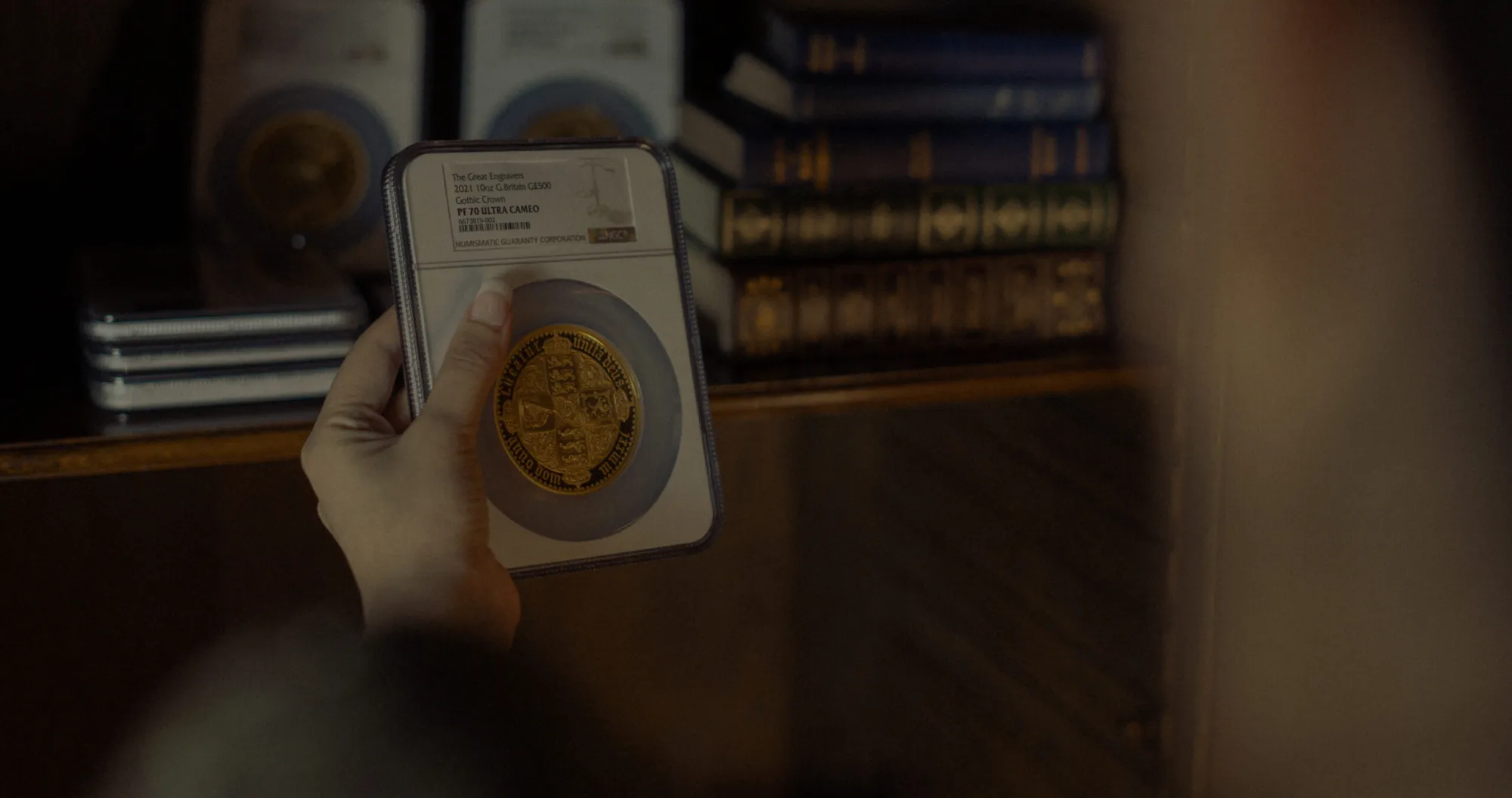
One coin, one number, out of seventy
A coin goes to NGC or PCGS, is examined under magnification against a published standard, and comes back with a score. The full scale runs from 1 to 70. Coins worn smooth by pockets and tills occupy the lower reaches; the coins worth collecting live in the top eleven points, and that is the stretch below.
Grades are assigned by NGC and PCGS, two independent companies paid to give a verdict rather than to buy or sell. Their scores are the shorthand the coin market runs on.
The same coin, with and without the verdict
Take one coin. Grade it, seal it, and nothing about the gold has changed. What changes is how much anyone has to take on trust, now and every time it changes hands afterwards.
| Feature | Graded and sealed | Loose |
|---|---|---|
| Condition | Scored out of 70 by an independent grader, and stated on the label | Your own judgement, or the seller's |
| Authenticity | Verified before sealing, and listed by serial number on the grader's own site | Taken on trust, or checked at your own cost |
| Protection | Sealed in a tamper-proof holder, so the condition it was scored at is the condition it keeps | Exposed to fingerprints, knocks and air, all of which cost condition over time |
| Selling it on | A buyer anywhere reads the label and knows exactly what is on offer | Every sale reopens the same argument about what condition it is really in |
| What sets the price | The gold, plus condition, rarity and collector demand | Mostly the gold |
| The trade-off | Grading has to be paid for, and a sealed coin is a coin you will never hold in your hand | Cheaper to buy, and you can turn it over in your fingers whenever you like |
Grading does not turn an ordinary coin into a rare one. It settles what you have, so that the argument is over before it starts.
How rare is rare?
Mintage is the number struck. It is fixed on the day the dies come off the press and never moves again, whatever happens to the gold price. These are proof mintages from the modern Royal Mint series, checked issue by issue.
Struck is not the same as survived
A mintage tells you how many left the press. It does not tell you how many still exist untouched, and of a run of a few hundred only a fraction ever earn the highest grades. That is why the two numbers matter together: how many were made, and how many have been graded at each score since.
The second number, population
NGC and PCGS publish how many examples of each coin they have graded, and at what score. Where a mintage is a closed historical fact, a population report is a running tally, and it is the closest thing the market has to a headcount of the survivors at the top of the scale.
Proof mintages for the issues shown. Proof and bullion strikes of the same coin are separate products with separate mintages, and the two are often quoted added together; the figures here are the proof strike alone. For scale, the bullion Sovereign of a single year has run to tens of thousands of coins, and in some years far more.
British gold, taxed unusually kindly
There is a practical reason the collection is built from Royal Mint coins rather than anything that happens to be gold. UK legal tender occupies a corner of the tax system that almost nothing else does.
No VAT to pay
Investment-grade gold carries no VAT in the United Kingdom. What you pay for is the coin, not the coin plus a fifth.
No Capital Gains Tax
Royal Mint coins that are UK legal tender, Sovereigns, Britannias and the gold crowns among them, are exempt from Capital Gains Tax however much they appreciate. Most assets are not, and the difference compounds quietly over a long holding.
Tax treatment depends on your individual circumstances and the rules can change. Bullion Club is not a tax adviser and does not give tax advice; if your position is complicated, take professional advice before you buy.
- Royal Mint coins exclusively. One mint, one standard, and a body of work collectors already follow closely.
- Legal tender, not just metal. A face value stamped on the coin is what puts it inside the exemption.
- 22 carat or finer. The gold content is never the question; condition and rarity are where the work goes.
- Sold coin by coin. A collection can be released in pieces rather than all at once, which a single large bar cannot do.
“Honest, warm and never pushy. They even advised me to hold off once. That’s when I knew I could trust them.”
Frequently asked
Graded coins are almost always worth more than their ungraded twins, because the buyer is no longer guessing at condition or authenticity. What grading cannot do is improve the coin. A modest coin in a holder is still a modest coin; the label simply says so honestly.
Nothing happens to the gold, but the certification stops applying. The grade belongs to the sealed coin, not to the coin loose on a table, and a broken holder is treated as an ungraded coin from that moment on. It can be sent back and graded again, though it will be judged on whatever condition it is in by then.
They are the two independent grading companies whose scores lead the coin market. The reason their word carries is structural: they are paid to give a verdict, not to buy or sell the coins they are judging, so they have nothing to gain from a generous score. Every coin they seal is listed by serial number on their own website, which means their work can be checked by anyone.
To your eye, almost never. A 69 has a flaw or two visible only under magnification, and across a room the two coins are identical. The difference is in scarcity rather than in beauty: far fewer coins come back perfect than come back very nearly perfect, and it is that shortage the market prices. Whether the step up is worth paying for depends on the coin, and your specialist will tell you when it is not.
Easier, usually. A sealed coin describes itself: grade, year, serial, all on the label, so a buyer does not need to inspect it or trust you. When the day comes, the same desk that built your collection will quote to buy it back, with settlement typically within 48 hours of your coins being verified, and you can sell a single coin rather than the whole collection.
Bring the questions, keep the answers
Fifteen minutes with a specialist, and no decision asked of you on the day. Grades, mintages, what a given budget realistically buys: ask any of it. If gold is not right for you, we will say so.