In Q1 2025, the Royal Mint reported a 306% year-on-year surge in gold coin demand. But not all gold coins are equal, and the difference between a loose coin and a graded coin can mean thousands of pounds in value.
A graded gold coin has been independently authenticated, condition-scored, and permanently sealed by a trusted third party. That verification transforms it from a commodity into a certified investment asset: one that is easier to value, easier to sell, and eligible for Capital Gains Tax exemption when it carries UK legal tender status.
One Bullion Club client, profiled in The Telegraph in December 2025, built a portfolio of 28 graded Royal Mint coins worth £120,000 and has already seen £16,000 in tax-free profit. This guide explains how coin grading works, what the grades mean, and why graded gold coins have become the preferred choice for serious UK investors.
What Is Coin Grading?
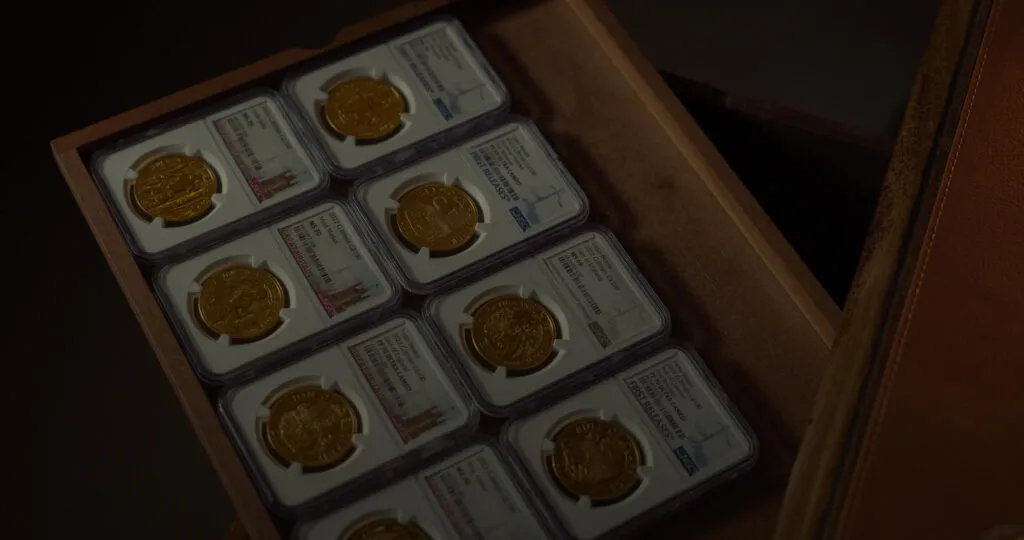
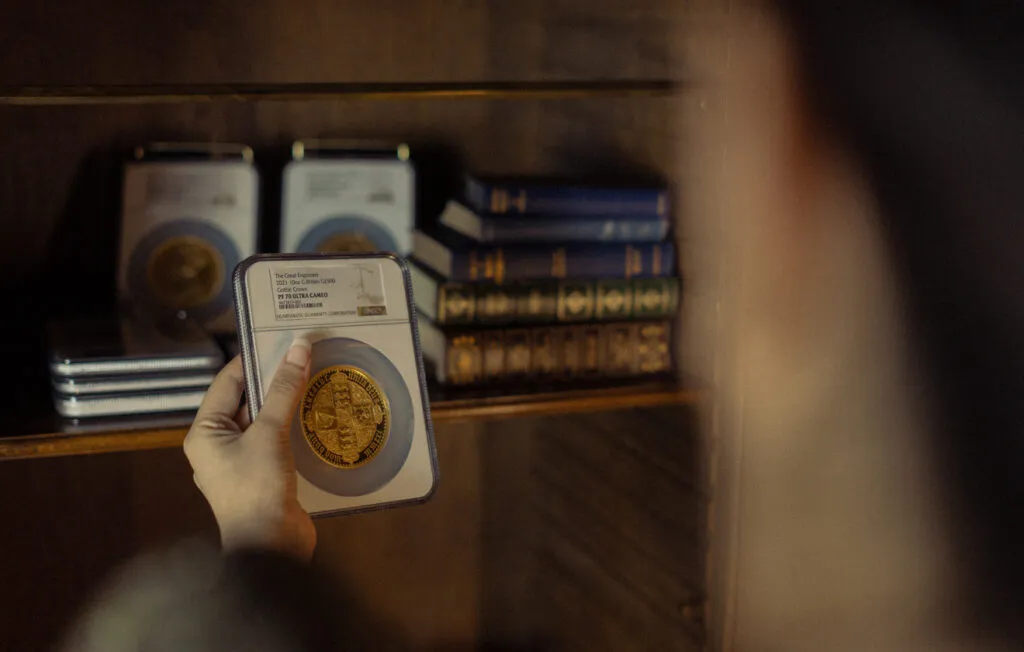
Coin grading is the professional assessment of a coin’s condition by an independent authority. The coin is examined, assigned a numerical score on a standardised scale, and sealed in a tamper-proof holder called a “slab.” The slab displays the grade, a unique certification number, and a description, creating a permanent, verifiable record of the coin’s authenticity and condition.
The two globally recognised coin grading services are:
- NGC (Numismatic Guaranty Corporation): founded in 1987, NGC has certified over 60 million coins. It is the most widely used grading service for UK and European coins, including Royal Mint issues.
- PCGS (Professional Coin Grading Service): founded in 1986, PCGS pioneered the modern grading system. Together with NGC, they have certified over 100 million coins worldwide, creating a standardised global marketplace.
Every graded coin can be verified online using its certification number, at ngccoin.uk for NGC coins or pcgs.com/cert for PCGS coins, providing instant confirmation of authenticity and grade.
The Coin Grading Scale: 1 to 70
Both NGC and PCGS use the Sheldon scale, a 70-point system developed by Dr William Sheldon in 1949. Coins score from 1 (barely identifiable) to 70 (absolutely perfect). For investment-grade gold coins, you will encounter two categories.
Mint State (MS) grades for bullion coins
Mint State coins have never been circulated.
| Grade | Condition | Investor Significance |
|---|---|---|
| MS 65-66 | Gem quality. Minor marks under magnification. | Entry-level investment grade. Lowest premium over spot price. |
| MS 67-68 | Superb gem. Near-perfect surfaces. | Strong investment grade. Moderate numismatic premium. |
| MS 69 | Near-perfect. Virtually flawless. | Premium investment grade. High collector demand. |
| MS 70 | Perfect. Zero imperfections under 5x magnification. | Highest possible grade. Maximum numismatic premium. |
Proof (PF) grades for proof coins
Proof coins are specially struck using polished dies, producing a mirror finish with frosted design elements. Same 1 to 70 scale, PF prefix.
| Grade | Condition | Investor Significance |
|---|---|---|
| PF 69 | Near-perfect proof. Benchmark for modern proof coins. | Standard investment grade. Most modern Royal Mint proofs achieve PF 69+. |
| PF 70 | Perfect proof. Flawless in every respect. | Significantly rarer. As few as 5 to 15% of a mintage may achieve PF 70. |
What a single grade point is worth
The gap between PF 69 and PF 70 sounds small. It is not. A 2024 Gold Britannia proof graded PF 69 might trade at a 10 to 15% premium over the gold spot price. The same coin graded PF 70 could command a 30 to 50%+ premium. The gold content is identical; the difference is entirely in certified condition and scarcity.
This is the core investment thesis for graded coins: you own the same gold, but a higher grade unlocks a premium that can grow independently of the gold price.
Considering graded coins for your portfolio? Book a free call with one of our specialists to discuss how grading fits your investment goals.
5 Reasons Graded Coins Outperform Loose Coins
An ungraded gold coin and a graded gold coin contain the same gold. So why does the graded coin consistently sell for more?
1. Authenticated against counterfeits
Every NGC and PCGS coin has been examined by professional numismatists and confirmed genuine. The Royal Mint has publicly warned about counterfeit Britannias and Sovereigns in circulation, making independent authentication a necessity, not a luxury. Each coin’s certification number is permanently recorded in the grading company’s database for instant online verification.
2. Condition locked in permanently
Once sealed in its tamper-proof slab, a coin’s condition cannot deteriorate. No handling damage, no environmental tarnishing, no accidental scratches. An ungraded coin has no such protection, and no independent proof of its condition when you come to sell.
3. Faster, more confident resale
Graded coins are easier to sell. Buyers anywhere in the world trust NGC and PCGS grades: no negotiation over condition, no independent inspection needed. This liquidity matters. When you want to sell, a graded coin finds a buyer faster and at a more predictable price than an ungraded equivalent.
4. Two sources of return, not one
Loose gold coins track the gold price. That is your only return driver. Graded coins add a second: the numismatic premium. As collector demand grows or coins become scarcer in a particular grade, the premium above melt value can appreciate independently of gold. Both returns are Capital Gains Tax free on UK legal tender coins.
5. Transparent, standardised pricing
The universal grading scale means graded coins have established, verifiable market values. Dealers, auction houses, and private buyers worldwide reference the same standards, reducing the risk of overpaying and making portfolio valuation straightforward.
Graded vs Loose Gold Coins: Side by Side
| Feature | Graded Gold Coin | Loose (Ungraded) Gold Coin |
|---|---|---|
| Authenticity | Independently verified by NGC/PCGS | Buyer must trust the seller |
| Condition | Objectively scored on 1 to 70 scale, sealed | Subjective assessment, can deteriorate |
| Protection | Tamper-proof slab with hologram and serial number | Vulnerable to handling and environmental damage |
| Resale value | Gold value + numismatic premium | Typically gold melt value only |
| Liquidity | Globally recognised, faster to sell | May require inspection before sale |
| Price transparency | Standardised market pricing by grade | Variable, dealer-dependent |
| Counterfeit risk | Eliminated by professional authentication | Risk remains without verification |
| Tax (UK) | CGT-exempt if UK legal tender | CGT-exempt if UK legal tender |
Which Royal Mint Coins Can Be Graded?
Any coin can be submitted for grading, but for UK investors the most relevant are Royal Mint issues. These carry UK legal tender status, making them exempt from both VAT and Capital Gains Tax.
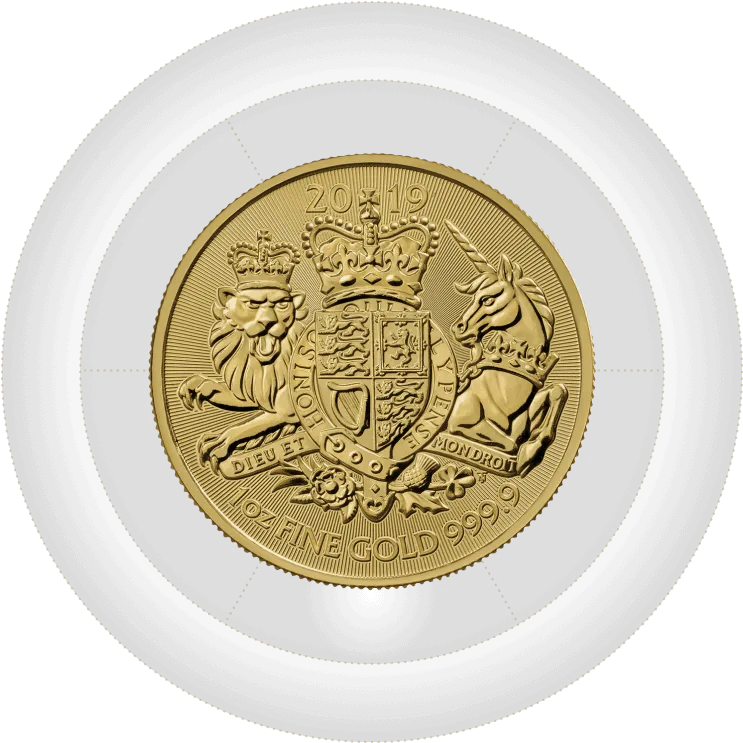
- Gold Britannias: the UK’s flagship 1oz bullion coin. 999.9 fine gold, £100 face value. Available in bullion and proof finishes. Read our complete Britannia guide.
- Gold Sovereigns: Britain’s historic gold coin, minted since 1817. 22-carat gold, 7.32g gold content. Full, half, and quarter Sovereigns are all graded.
- Queen’s Beasts series: 10 heraldic beast designs, minted 2016 to 2021. Strong secondary market demand for high-grade examples.
- Tudor Beasts series: the current successor, being issued now.
- Lunar series: Chinese zodiac-themed gold coins from the Royal Mint.
- Commemorative and proof sets: jubilee, coronation, and limited-edition releases. Often the lowest mintages (500 to 2,500 pieces) and highest premiums at PF 70.
All of these are exempt from VAT on purchase and CGT on sale, with no annual limit. Learn more about the tax advantages of gold coins.
How Coin Grading Works: The 5-Step Process
- Submission. The coin is sent to NGC or PCGS in secure, insured packaging. Authorised dealers like Bullion Club handle submissions on behalf of clients.
- Authentication. Numismatists verify the coin is genuine by checking weight, dimensions, metal composition, and design details.
- Grading. Multiple independent graders assess condition on the 1 to 70 Sheldon scale. Their scores are combined to determine the final grade, reducing individual bias.
- Encapsulation. The coin is sealed in a tamper-proof slab with its grade, description, and unique certification number. NGC uses a hologram; PCGS uses a gold shield security feature.
- Registry. Details are entered into the grading company’s online database for permanent verification.
The process takes 2 to 8 weeks. At Bullion Club, every coin we sell is already professionally graded. Our clients never need to handle the submission process.
NGC vs PCGS: How the Two Grading Services Compare
Both are equally respected. Between them, over 100 million coins certified. For UK investors the differences are minor:
| Feature | NGC | PCGS |
|---|---|---|
| Founded | 1987 | 1986 |
| Coins certified | 60+ million | 50+ million |
| UK/European coins | More widely used for Royal Mint | Slightly less common |
| US coins | Strong | Strongest |
| Scale | Sheldon 1 to 70 | Sheldon 1 to 70 |
| Slab security | Hologram | Gold shield |
| Acceptance | Universal | Universal |
For Royal Mint coins, NGC-graded examples are the most commonly available in the UK market. PCGS-graded coins are equally valid and hold the same market value at equivalent grades.
Are Graded Gold Coins a Good Investment?
For UK investors, the case is strong. But it is important to weigh both sides honestly.
Why investors choose graded coins
- Dual return potential. Gold price appreciation plus numismatic premium growth, both CGT-free. In a rising gold market, graded coins can outperform bars because the numismatic premium amplifies returns.
- Built-in downside protection. The coin’s gold content provides a hard floor value. Even if the collectible premium contracts, you still own the underlying gold.
- Verified scarcity. Many Royal Mint proofs have mintages of 500 to 2,500. Of those, only a fraction achieve PF 70, creating genuine, verifiable rarity that underpins premium values.
- Double tax exemption. No VAT on purchase, no CGT on sale, no annual limit. Compare that to ISAs (£20,000/year cap) or pensions (£60,000/year cap).
- Global liquidity. NGC and PCGS grades are recognised by dealers and auction houses worldwide.
What to consider
- Higher entry cost. Graded coins carry a premium above equivalent loose coins. This reflects authentication and certification, but it means graded coins are best suited to a medium to long-term horizon (3+ years).
- No yield. Physical gold pays no dividends or interest. Returns come entirely from price appreciation.
- Storage required. Coins need secure storage, at home or in a professional vault. Bullion Club offers 12 months’ free vault storage at our Heathrow facility with every purchase.
Frequently Asked Questions
What does “graded” mean for a gold coin?
A graded gold coin has been professionally assessed by NGC or PCGS, assigned a condition score on the 1 to 70 Sheldon scale, and sealed in a tamper-proof holder. The grade confirms authenticity and condition, and can be verified online at any time.

Are graded gold coins CGT-free in the UK?
Yes, if the coin is UK legal tender. Gold Britannias, Sovereigns, and other Royal Mint coins are exempt from Capital Gains Tax regardless of the profit made. Grading does not affect the tax status. The exemption applies to both graded and ungraded UK legal tender coins.
Is NGC or PCGS better?
Both are equally trusted and use the same 1 to 70 grading scale. NGC is more commonly used for UK and European coins. PCGS has a slightly stronger US presence. Coins graded by either service hold the same market value at equivalent grades.
How much more are graded coins worth than ungraded?
It depends on the coin and grade. As a general guide, a graded Britannia at PF 69 might trade at 10 to 15% above spot, while PF 70 can command 30 to 50%+ above spot. The premium reflects certified condition and scarcity, particularly for limited-mintage proof coins.
Can I sell graded coins back easily?
Yes. Graded coins are among the most liquid forms of physical gold investment because the grade removes uncertainty for buyers. At Bullion Club, we offer a buy-back guarantee on every coin we sell.
Why Bullion Club for Graded Gold Coins
At Bullion Club, graded gold coins are at the heart of what we do. We source NGC and PCGS-certified Royal Mint coins for UK investors, focusing on investment-grade pieces that combine gold exposure with numismatic upside.
Our founder, Harry Thorne, was featured in The Times discussing the growing demand for certified gold coins among UK investors. We have also been profiled in The Telegraph, GB News, and the MoneyMagpie Invest podcast.
Every client receives:
- A dedicated account manager who builds a portfolio tailored to your goals.
- Full NGC or PCGS certification on every coin.
- Free insured delivery or 12 months’ free vault storage at our Heathrow facility.
- Buy-back guarantee: when you are ready to sell, we will buy your coins back at a competitive price.
- Ongoing portfolio support and market updates.
We hold a Feefo Platinum Trusted Service Award (2024, 2025, and 2026) with a 5/5 customer rating.
Ready to explore graded gold coins? Book a free, no-obligation call with one of our gold specialists.